

THE QUICK ANSWER
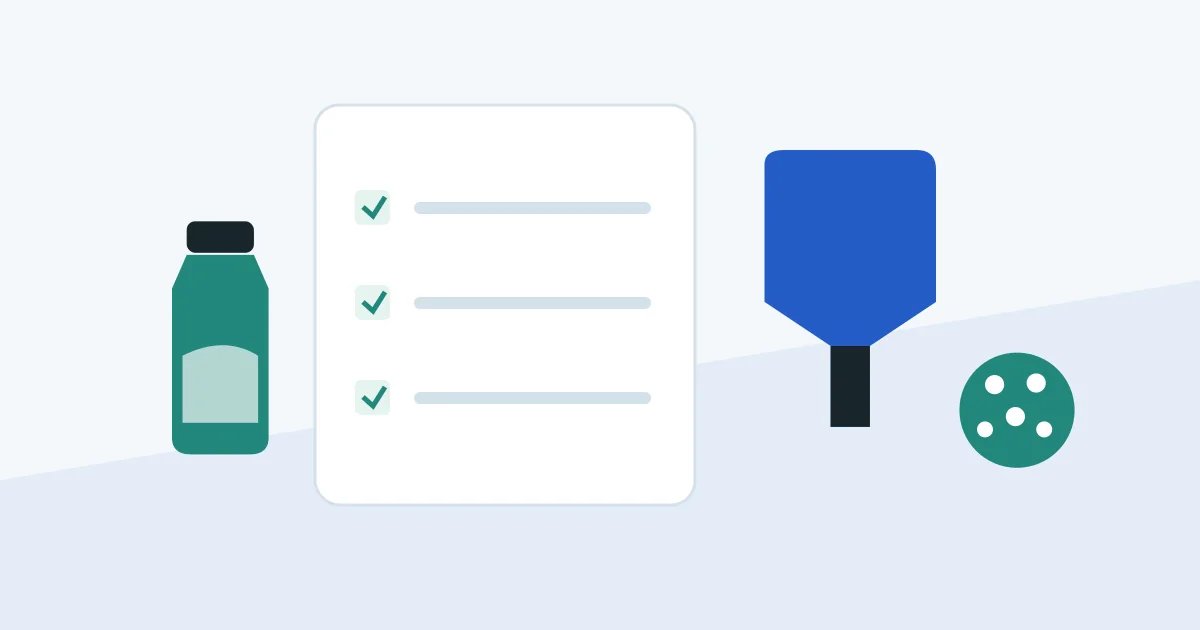
Lay out your normal kit first, then check the covered paddle fit, separate space for used gear, access to small items and comfort carrying the full load. Pocket layout matters as much as overall size.

The right pickleball bag is the one that carries your normal kit without making you unpack everything to find a ball. Start with what you bring to a real session, then compare how each bag holds it. A large paddle-count claim or an impressive pocket total does not answer that question on its own.
This guide gives you a packing layout and a loaded-bag checklist. It is a way to compare bags, not a ranking or a hands-on review of particular models.
Lay out your normal kit before choosing a size
Put your usual court-day equipment on a table. Include the cover you use on your paddle, your actual bottle and any shoes or clothing you carry separately. Decide which items travel every time and which belong only on longer days.
| Pack for a normal session | Add only when your plans require it |
|---|---|
| Paddle in its cover | A spare paddle or equipment for another player |
| The ball your group uses, plus a spare if needed | Extra balls for drills |
| Your water bottle and small towel | Change of clothes or a larger towel |
| Phone, keys and any grip supplies you use | Shoes, work items or a packed meal |
This is a planning list, not a venue requirement. Check which ball your session uses rather than filling a pocket with several unrelated models.
If you already own a backpack that fits this kit, use it as your starting comparison. Record what is awkward about it. A specific problem such as “my covered paddle catches on the opening” is more useful than a vague wish for more storage.
Choose the carrying format for your routine
A compact sling or small bag is worth trying when you carry a light kit. A backpack is worth comparing when you also bring shoes, clothes or work items. A larger bag may suit shared equipment or a longer day. These are starting points, not capacity guarantees: the exact compartment layout matters more than the category name.
Selkirk's official bag comparison page separates dimensions, paddle sleeves, primary access, ball storage, shoe storage and harness system. Use those as separate questions when reading a listing. A bag can have plenty of overall space and still lack the opening or dedicated area you want.
For example, JOOLA's Vision II Backpack description identifies a ventilated shoe partition, exterior pockets and a side mesh bottle pocket. That shows the kind of detail to check on a specific model; it does not mean every backpack has those features.
Check the paddle area with the cover on
Compare the paddle compartment's usable opening and space with your covered paddle. Overall bag dimensions describe the outside, not necessarily the size of an internal sleeve. If a listing omits useful compartment measurements, ask the seller or try the bag before relying on an advertised paddle count.
When you can inspect it, insert and remove your covered paddle. Check that the zipper closes normally without pressing hard against the paddle or bending the opening around it. Then add the rest of your kit and repeat: a sleeve that feels roomy in an empty bag may be less convenient when adjacent pockets are filled.
For multiple paddles, check how they sit together. Look for separation or use suitable covers so the packing arrangement does not put loose keys or other hard objects against the faces. See our paddle-care checklist for the before-and-after routine.
Give used gear and small items separate places
Use the illustrated zones as a packing plan, not a requirement that every bag have four built-in compartments. A separate pouch can help organize a simple main compartment. Check whether a shoe pocket takes space away from the area you need for other gear.
Give keys and your phone a predictable pocket. Keep balls contained so retrieving one does not involve moving everything else. Test the bottle pocket with your actual bottle; its shape, cap and fit matter more than how the empty pocket looks in a photograph. Secure the cap before packing.
A pocket described as ventilated is not automatically waterproof or a sealed wet compartment. Check the exact construction rather than assuming it will contain a leak. Keep damp items separate from the paddle and unpack them after the session.
Run a four-part loaded-bag check

Bring your kit when trying a bag, where the shop permits it. Walk with the loaded bag and adjust its strap or straps. Reach for the items you use most often. Check that the bag's opening and pocket layout work for the way you set it down at your usual court.
Keep a short comparison record rather than trying to remember a dozen features:
| Question | What to record for each candidate |
|---|---|
| Does my covered paddle fit? | Sleeve/opening information or what you observed |
| Where do shoes and a used towel go? | Separate space, pouch, or a gap to resolve |
| Can I reach the small essentials? | Pocket used for balls, keys and phone |
| Does my bottle fit securely? | Your bottle and pocket combination |
| How does it carry with my kit? | Your own comfort and access observations |
| What remains uncertain? | Missing dimensions, care instructions or return terms |
Do not treat a bag as safe storage in a hot car
Selkirk's paddle-care guidance recommends bringing paddles in from the car or garage and storing them in a dry, room-temperature location. Follow the instructions for your exact paddle. An insulated-pocket label alone is not a reason to assume a packed paddle can stay safely in a hot car.
Netside's planned bags are still in development. The illustrations here are conceptual packing examples, not product specifications, stock announcements or evidence of tested protection. Use the same fit-and-access checks for any eventual Netside bag as you would for another brand.
Sources & editorial note
- Selkirk: official pickleball bag comparison categories
- JOOLA: Vision II Backpack compartment description
- Selkirk: paddle care and storage guidance
Sources checked 2026-10-19. This guide was prepared with AI assistance and checked against the sources above. Read our editorial standards.
MEET THE BRAND
A new side of pickleball.
Netside's first US lineup is in development. Explore the paddle designs while final specifications are being confirmed.
Explore Netside paddles